

About
About University
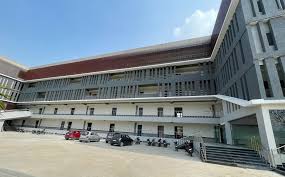
Koneru Lakshmaiah Education Foundation (KLEF)
Deemed to be university established in 1980-81, offering outstanding undergraduate, postgraduate and doctoral programmes in engineering and management.
Koneru Lakshmaiah Education Foundation (KLEF) Deemed to be university was established in 1980-81, as KL College of Engineering, which was upgraded to KL College of Engineering Autonomous in 2006 by UGC, and was declared as a Deemed to be University in 2009 by UGC, MHRD Government of India. The first off campus, has come up in A.Y 2018-2019 at Hyderabad, Moinabad, Aziznagar Road, near TSPA Junction, on the road leading to Chilkur Balaji temple. KLEF has inaugurated its second off campus in A.Y. 2023-2024 in Bowrampet Village, Medchal, Malkajgiri District, Greater Hyderabad. University offers outstanding undergraduate, postgraduate and doctoral programmes in engineering and management streams from two campuses Vijayawada and Hyderabad. KLEF has established an ecosystem to promote innovation, including a centre for Innovation, Incubation and Entrepreneurship Cell (IIEC), leading to start-ups in different disciplines. Through publishing research articles in various national and international refereed journals, particularly in Scopus/WoS/SCI Indexed journals, research has taken a quantum leap towards improving its quality, resulting in good h-index.
About ECE Department
Department of Electronics and Communication Engineering (ECE)
Established: 2023
Programs Offered: Undergraduate (B.Tech.) and Doctoral (Ph.D.) programs
The Department of Electronics and Communication Engineering (ECE) was established in the year 2023 and offers Undergraduate (B.Tech.) and Doctoral (Ph.D.) programs. The department takes pride in its highly qualified faculty, with academic and research backgrounds from reputed international universities such as Arizona State University (USA), University of Texas (USA), and Pusan National University (Republic of Korea), as well as premier national institutions including IITs, IISc, NITs, BITS and Top Central Universities. This strong academic foundation enables the department to deliver quality education, cutting-edge research, and industry-relevant training. Electronics and Communication Engineering is a diverse and rapidly evolving discipline encompassing a wide range of sub-fields such as Analog and Digital Electronics, VLSI Design, Micro/Nano-electronics, 4G/5G Communication Systems, Radio and Satellite Communications, Embedded Systems, Signal and Image Processing, Robotics, Internet of Things (IoT), Smart Cities, Edge Computing, Artificial Intelligence, Quantum Circuitry, Photonics, Renewable Energy Systems and many other emerging technologies. The ECE discipline uses advanced simulation tools, algorithms, and fabrication technologies to design and develop active and passive electronic devices such as diodes, transistors, semiconductor devices, and integrated circuits, enabling applications in electronic circuits, VLSI systems, PCBs, nano-devices, and related systems.

About ROCV-AI 2026

ROCV-AI 2026 (International Conference on Emerging Trends in Robotics, Communication, VLSI, and Artificial Intelligence)
ROCV-AI 2026 (International Conference on Emerging Trends in Robotics, Communication, VLSI, and Artificial Intelligence) aims to serve as a premier global forum for researchers, academicians, and industry professionals. The conference focuses on emerging and integrated intelligent systems that seamlessly combine robotics, electronics, VLSI hardware, embedded systems, communication technologies, and advanced AI algorithms. Key thrust areas include AI-driven robotics, on-chip intelligence and VLSI architectures, secure and low-power electronic systems, and next-generation communication technologies. ROCV-AI 2026 emphasizes advancements in Artificial Intelligence, Machine Learning, and Deep Learning for intelligent, connected, and real-time robotic and cyber-physical applications. The conference also highlights innovations in algorithms for sensing, perception, control, signal processing, communication, networking, and system optimization, with a strong focus on hardware-aware AI, edge intelligence, and communication-efficient robotic systems. Industry-focused sessions and expert keynote talks aim to bridge the gap between theoretical research and real-world deployment. ROCV-AI 2026 promotes collaboration, knowledge exchange, and impactful research in AI-powered robotics, VLSI systems, electronics, and communication technologies.
Organized by: Department of Electronics and Communication Engineering, KL University, Bowrampet Campus, Hyderabad